Toilet Talk: When To Call Your Plumber

Calling your local plumbing services for maintenance can be one of those to-do list tasks that keeps getting put off. It can often feel like a hassle, and if nothing is obviously broken or wrong, your regular plumbing maintenance can be easy to ignore. However, if you notice any of these signs, you'll want to hurry up and call your local plumbers.

Fixtures Backing Up

Backed up sinks or toilets can be a huge problem for your home plumbing. Sewage backing up in your fixtures can even potentially cause health hazards if left untreated, so if you notice that your sewage is backed up in any part of your house, call your local plumbers immediately.

Water Temperature Changes

Is your shower just not quite as hot as you remember it being? It could be that there's a problem with your water heater. Showering and bathing take up most of the indoor water use in your home, meaning that a broken water heater can be especially annoying. Check the temperature of water in fixtures throughout your home, and if you notice something is off, you'll want to schedule water heater repair.

Leaking Fixtures

While that leaky faucet might seem easy to ignore or overlook, it could be wasting a significant amount of water in your home, eventually costing you a fair amount of money. In fact, household leaks can waste nearly 900 billion gallons annually in the United States alone. It's best to contact a plumber when you first notice a leaky faucet, rather than waiting; this ensures you aren't wasting too much water.

Stick To A Calendar

When was the last time you called a plumber to check on your pipes? If you can't remember, it might be a good idea to give a plumber a call, just in case. Sticking to a regular schedule for your plumbing maintenance can help you catch problems with your household plumbing before they would have otherwise shown up.

Are you overdue for a visit from your local plumbers? Have you had any of these signs of a plumbing issue in your home? Contact Greenwell Plumbing for more information on routine plumbing maintenance or to schedule plumbing services for your home.

Schedule Online(502) 205-2482
My Toilet is Overflowing. Now What?

It’s happened to all of us. We expect to hear the sound of water being flushed down the toilet, but it never comes. Then the unnerving sight as water just slowly keeps creeping towards the rim of the bowl. We panic, say a thousand mini prayers, and simply hope that the water stops before making the ultimate plunge over the edge and soaking your floor.

An overflowing toilet can bring out the worst in us. Granted, yes it’s an emergency. But it’s one that can be handled. Sometimes easily.

Don’t worry. We will get through this.

For starters, stop flushing.
It’s almost our first instinct, but we have to resist. Seriously, stop flushing. Your toilet is clogged. Adding more water on top of the clogged water only results in one thing – more water. We don’t want that. So, don’t do that.

Stop it at the source
If your toilet is overflowing, then we want the water to stop. For many toilets, this is as easy as turning off the water supply either behind or to the side of the toilet. To turn it off, simply turn the shut off valve clockwise to stop the water from filling the tank and overflowing the toilet.

The Backup Plan
If you can’t find the shutoff valve, or if it’s just not cooperating, don’t panic.
We have another way.

Your next stop should be the inside of the toilet tank.
Carefully remove the lid and set it aside.

We’re looking for the flapper: it’s usually a hinged rubber disc covering a hole at the bottom of the tank. If the flapper is open, reach in and close it manually. This should stop the flow of water.

If the flapper is not open, then find the float ball. This is the component that floats on the surface of the water and stops the tank from filling at a certain level. If you manually lift the float ball to the top of the tank, the water will shut off.

It’s a waiting game
Ok. The hard part is over. We’ve stopped the water. Now before we can attack that clog, we have to wait for the water inside the bowl to recede.

If the water doesn’t recede, then you know that you have a pretty serious clog. Which means you may have to call in the reinforcements.

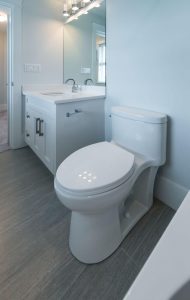
toilet in bathroomPlunge
Assuming a clog in the plumbing is your problem, a good plunge may fix the issue.  You may be thinking, I got this.

Believe it or not, many people do not know how to plunge properly. So, here’s a refresher on the proper steps:

  1. Place the plunger in the toilet. Let the water in the toilet flow over the head of the plunger. This creates a good seal between the toilet bowl and the plunger. If there isn’t enough water in the toilet to cover the head of the plunger, you’ll need to turn the water back on and flush the toilet. Once the toilet has been flushed, you’ll have to act quickly to prevent the bowl from overflowing again.
  2. Pump the plunger up and down rapidly about 6 times, then pull the plunger up quickly. Watch to see if the water level goes down.
  3. Repeat steps one and two until the toilet is flushing well.
  4. Try not to clog the toilet again.
Schedule Online(502) 205-2482